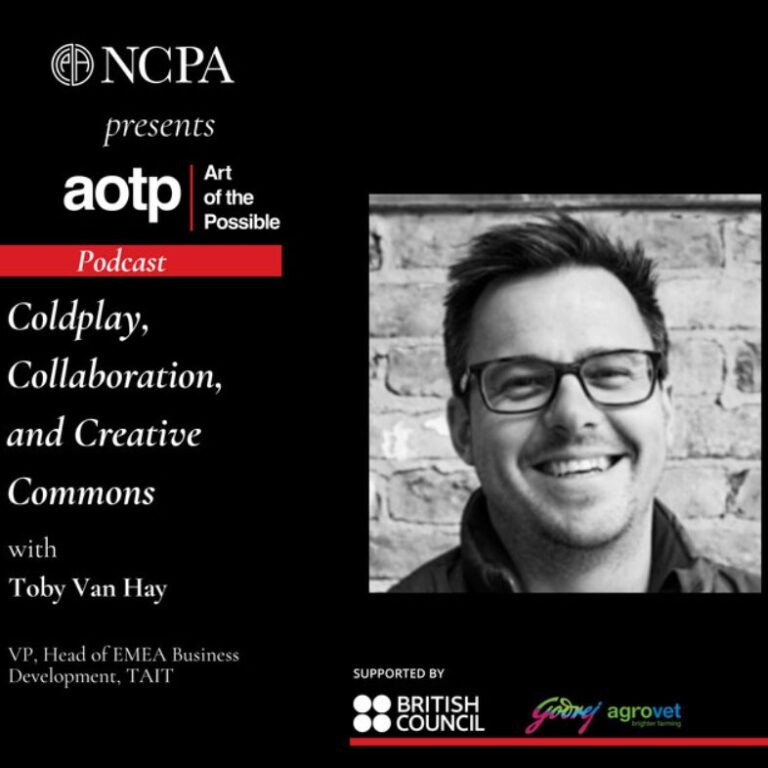
For this episode of the AOTP Podcast, we sit down with Toby Van Hay, Vice President and Head of Business Development for Europe, Middle East and Africa at TAIT, the global engineering and creative powerhouse behind some of the world’s most ambitious live experiences. If you have watched Coldplay’s Music of the Spheres concert in India, you have already witnessed the scale of work TAIT brings to life.
With over two decades in the industry, Toby brings a perspective shaped by theatre, engineering, brand events, immersive installations and large-scale touring productions. His journey has taken him across sectors, countries and creative landscapes. At the core of it all is one throughline: an unwavering commitment to designing experiences that move people.

The Power of Experience
Toby begins by reflecting on the shift he sees across the global entertainment industry. The boundaries between theatre, concerts, immersive installations and location-based entertainment are dissolving. What matters now is experience.
He points to a recurring theme that surfaced in the AOTP symposium panels. Whether a venue is a theatre, a stadium or a cruise ship, audiences come seeking connection. They want music, art, performance and storytelling to co-exist in ways that feel seamless, accessible and emotionally resonant.
He explains that TAIT’s work has increasingly centered on this intersection of engineering and guest experience. Designing a theatre today is not simply about designing a stage. It is about creating a space where communities gather, children learn, amateur groups perform and audiences return for inspiration. The future of venues, he suggests, lies in multi-use spaces that anchor culture as a lived, everyday experience.
A Global View of Education and Skills
Toby highlights another central thread of the conversation. Education
Having worked with universities, corporate partners, theatre institutions and technical teams across continents, he sees how training and skills necessarily evolve with each region. A model that works in the UK may not work in India. Methods that succeed in America may not translate directly to Europe.
For him, the starting point is always listening. Understanding local needs, existing knowledge systems and the unique creative environment of a place. He believes that institutions like NCPA, together with platforms like AOTP, can play a vital role here by opening rooms for dialogue between venue operators, educators, technicians and industry partners.
“What we are doing here is incredibly important,” he says. “It is the right conversation at the right time.”
A Career Built on Curiosity
Toby’s own journey is shaped by curiosity rather than linear career planning. Dyslexic and unsure of his path as a student, he pivoted mid-university into events and later moved across brand work, production companies, engineering environments and touring shows.
He believes the creative industries allow for movement in every direction. There is no single correct route. One can grow technically, shift laterally, or enter entirely new sectors without losing the essence of the work.
“I like people. I like events. I like shows. That was as far as I got,” he laughs. The rest became a journey that continues to evolve.
For young professionals, his advice is simple: keep learning and stay open. Roles change. Industries shift. Curiosity is the most sustainable skill.

What Venues Owe Their Communities
The conversation circles back to venues. Toby emphasises that the responsibility of a venue is bigger than the stage it houses. Education, guest experience and community engagement all play a role in how a space thrives.
He points out how stadiums across the world are rethinking their identities, expanding beyond sports to host concerts, festivals and hybrid events. Theatres, similarly, are looking at ways to welcome people through cafes, community programming, amateur performances and educational offerings.
The future, he says, is collaborative. Venues, industry partners and educational spaces need to come together to build long-term ecosystems that benefit both artists and audiences.
Creating a Shared Standards Framework
One of the core themes of the AOTP symposium was the possibility of creating shared standards for the sector while still respecting regional context. Toby sees this as essential.
AOTP, in his view, is well placed to spark this shift. By providing a platform where practitioners, educators, venue operators and partners come together, AOTP can help shape workflows, best practice documents and examples that guide the sector toward greater consistency and safety.
He sees this not as standardisation for uniformity, but as creating pathways for technicians and creative workers to grow with confidence.
Collaboration Across Borders
Toby acknowledges that international collaboration can be complex, but it begins with clarity and openness. TAIT’s work spans fixed installations, touring productions, immersive experiences and theme parks. What makes these collaborations work is a commitment to first understanding what partners want.
His philosophy is grounded in possibility. Nothing is impossible, he says. Creative work thrives when partners are willing to share ideas, build trust and bring the right expertise into the room.
For him, the magic happens not in what has already been done, but in the impossible ideas that push the industry forward.
Looking Ahead
The conversation with Toby reaffirms the vision that AOTP holds. A future where technical and creative professionals have access to knowledge, training and global networks. A future where learning sits at the heart of venue culture. A future where collaboration across institutions, regions and partners builds stronger cultural ecosystems.
His insights are a reminder that experience design is not just about technology. It is about people. It is about the stories we choose to tell. And it is about the spaces we build to hold those stories together.
If you enjoyed this conversation, you can listen to the full podcast episode with Toby Van Hay on the AOTP Podcast. Subscribe, rate and share the episode, and to learn more, visit aotp.in/.
Art of the Possible is supported by the British Council and Godrej Agrovet.