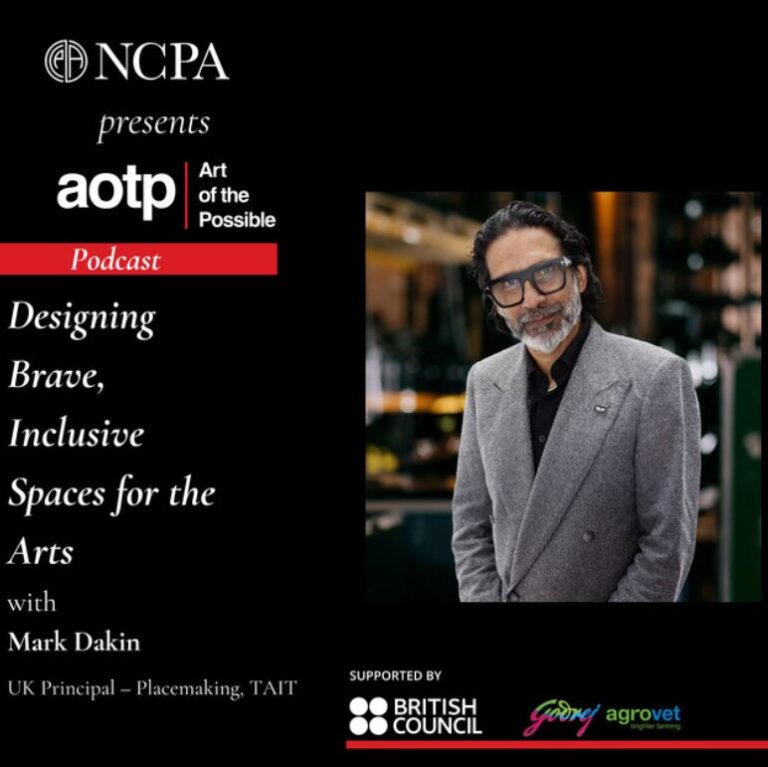
Few people have shaped the global live-events landscape as deeply as Mark Dakin, Principal at TAIT, the pioneering force behind world-class audience experiences for over four decades. If you have witnessed Coldplay’s Music of the Spheres concert or Taylor Swift’s Eras Tour, you have already seen TAIT in action.
With more than 45 years in technical direction and production, Dakin has led operations at the Royal Opera House, Covent Garden, and the National Theatre, London, before joining TAIT. In this episode of the AOTP Podcast, he speaks about collaboration across cultures, the need for stronger creative infrastructure in India, and why the future of live performance lies in building partnerships that connect technology, art, and people.

From the Opera House to TAIT
“TAIT is not Tate Modern,” Mark laughs. “We are the biggest unknown company in global entertainment.”
Headquartered in Pennsylvania, TAIT powers everything from stadium concerts to theme-park rides and cruise-ship theatres. In the last 18 months alone, the company has worked on Coldplay’s Mumbai show, the Taylor Swift tour, Harry Potter World Tokyo, and over 13 productions in London’s West End.
At the heart of it all, Dakin says, is technology that ties experiences together. It is not just about machinery but also about design, safety, and creativity. “Anyone can sell a hoist or control system,” he explains. “What matters is how that technology is implemented and how it creates opportunities for people to learn, grow, and collaborate.”
Collaboration Across Cultures
Having worked across the UK, US, Middle East, Japan, and now India, Dakin believes that the key to successful global collaboration is sensitivity.
“It is a mistake to think what works in one country will work in another,” he says. “When we work in Saudi Arabia or Japan, we adjust our approach to fit the cultural context. In India, we are doing the same, finding regional partners to build sustainable, creatively sympathetic relationships.”
Every new market, he adds, brings lessons. “Some things we do brilliantly; others we improve the next time. It is always a work in progress.”
Building Infrastructure for India’s Creative Future
India, Dakin notes, holds immense potential for the live-events industry. “You are a huge country with incredible creativity and talent,” he says. “But to host tours like Coldplay’s or to bring large-scale productions, we need the right infrastructure.”
TAIT is not here to prescribe what India should build, he clarifies, but to listen and collaborate. “It is about understanding what is needed, partnering with local experts, and supporting the creative community to design what fits the region.”
Beyond enabling international tours, Dakin sees this as a two-way opportunity to help Indian creativity reach global audiences. “The world wants content,” he says. “India has plenty of it.”

Setting Standards and Skilling Up
Dakin also points out that with new technology comes the responsibility to raise safety and training standards.
“Agreeing on standards is essential,” he says. “But they must make sense locally. Every new system or piece of tech should open a training opportunity for the current and future workforce.”
He envisions a pipeline from schools and colleges into the creative-tech sector, ensuring India’s next generation of technicians, designers, and producers can work confidently on global stages.
Why AOTP Matters
Reflecting on his experience with Art of the Possible, Dakin calls it a “fantastic foundation.”
“This project gives everyone a chance to join the conversation,” he says. “Technicians often do not get these opportunities, not because they do not want to, but because they are rarely invited into the room. AOTP can change that.”
For Dakin, AOTP represents not just a program but a movement toward empowerment, collaboration, and skill-building within the performing-arts and live-events ecosyste
If you enjoyed this conversation, you can listen to the full podcast episode with Mark Dakin on the AOTP Podcast. Subscribe, rate, and share the episode, and to learn more, visit aotp.in/.
Art of the Possible is supported by the British Council and Godrej Agrovet.