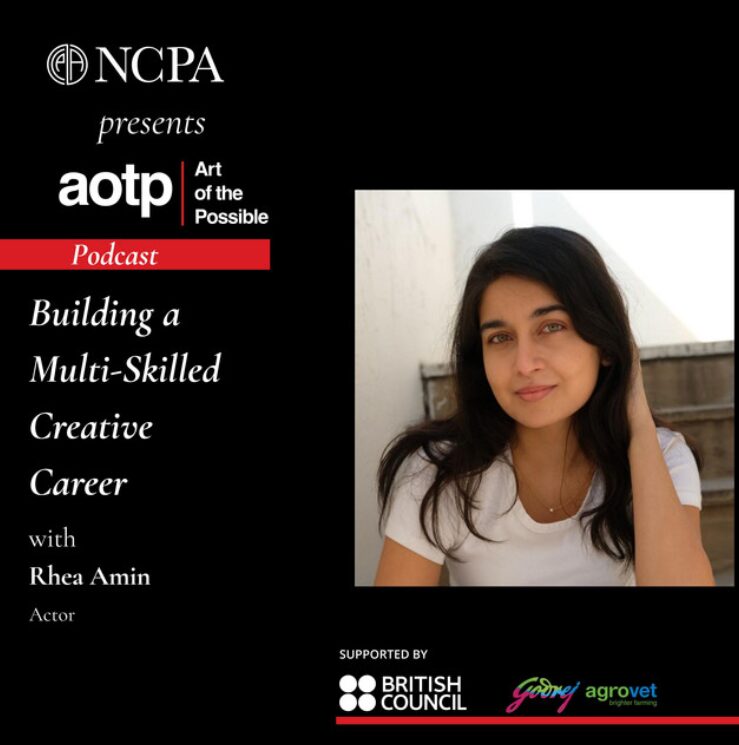
In the latest episode of the AOTP Podcast, we sit down with Spriha Naghare, a producer, stage manager and show caller whose work spans youth theatre, independent productions and large-scale musicals.
From leading TESPO, a youth theatre movement, to managing productions like Disney’s Aladdin, Sing India Sing and NCPA’s The Mirror Cracked, Spriha has worked across scales and formats. But at the core of her journey is something simple and honest: learning by doing.
“I’ve essentially been learning on the job.”
Spriha has largely worked in English theatre over the past decade and hopes to expand into regional theatre as well. When asked about the challenges she has faced, she does not offer a single dramatic turning point. Instead, she reflects on the practical realities of the profession.
“I think the biggest one has been financial,” she says.
Beyond that, the learning curve itself has been central to her journey. Once she began freelancing, there was no formal pathway to follow. Each project became its own classroom.
“I’ve essentially been working in largely English theatre and now hopefully will open up to more regional theatre as well.”
Across small productions with minimal sets and concise casts, to grand musicals with complex technical demands, every scale has required a different approach. No two projects have brought the same challenges.
The Burden and the Merit of Practical Learning
The conversation turns to a larger question: does learning on the job become a burden when formal training avenues are limited?
Spriha sees it as both.
“There were times and there are still times when I feel like if I know this skill set then I could kind of get better.”
Technical knowledge, especially lighting, is an area she continues to want to build. Knowing details of other departments, she believes, only strengthens her ability to manage productions more effectively.
At the same time, she is clear about the value of hands-on experience.
“There is also a lot of merit on learning on the job because actual practical learning… there’s really a lot of things that just register faster.”
For her, the immediacy of real-world production environments accelerates understanding in ways that theory sometimes cannot.
Why AOTP Matters Now
When asked why something like Art of the Possible is needed today, her response is direct.
“I think one thing is to… there will be some sense of jobs I guess.”
Visibility and access to opportunities are one part of the answer. The second is legitimacy.
“It will in a way legitimize what we do because there will be formal training that would be provided.”
She reflects on how even ten years ago, choosing theatre as a career invited skepticism at home. Today, with audiences showing up for both intimate performances and large musicals, the ecosystem feels more visible. Structured education and formal training programs would further validate backstage professions.
She also highlights accessibility.
“It will create more jobs and opportunities for a lot of people regardless of education background, economic background.”
For Spriha, that inclusivity is one of the strongest advantages of a platform like AOTP.
Building Something Concrete
Spriha was also part of the original research questionnaire conducted during lockdown. Even then, she found the initiative compelling because it was asking practical questions about how theatre actually functions.
“I’m hoping that something really concrete happens.”
If you enjoyed this conversation, you can listen to the full podcast episode with Toby Van Hay on the AOTP Podcast. Subscribe, rate and share the episode, and to learn more, visit aotp.in/.
Art of the Possible is supported by the British Council and Godrej Agrovet..